Showing posts with label discussion. Show all posts

Saturday, May 21, 2011

Discussion: Beyond Classifications

I am not a YA reader.

I am a reader, who likes YA.

degreedirectory.org
There is a difference, however slight. For instance, I might consider myself a writer who is Asian American, not an Asian American writer. In my opinion, labeling myself as an Asian American writer would pigeonhole me into a genre of expectations. It would be like me working with a certain set of parameters for a certain audience in mind. I'd rather my Asianness be just one part of the complex being that is me, and not an inflexible label.

This thought was inspired by the Diversity in YA event I attended last Saturday, during which the writers on the panel, all of whom are and write books about people of color or different sexual orientations, were asked if they felt like they had to represent their community in the publishing world. (I could be getting the wording of the question wrong, but that's the jist of it.) And one of the authors, I think it was Olugbemisola Rhuday-Perkovich, talked about how she thinks about all her writer identities, like she is a writer who is black, as well as a writer who likes cheese.

A writer who likes cheese? Bemi's answer struck me as being one of the wisest things I have heard lately. For what are we but a conglomeration of a million different things that make up who we are, and who's to tell us that one of those things has to define us at the exclusion of all others? I am a writer who is Asian American and a writer who loves chocolate. Does me being Asian American mean I can't write about my love of chocolate?

journalstar.com
I am a reader who likes YA because, above all, I search for literary quality and emotional resonance in the books I read. I want to be awed when I read the book. It happens rarely enough, finding that one book that awes me, but when it does it is so, so worth the 200 other books I read before finding that one. And those 201 books that I read range across all genres and reading age groups. So I am a reader, first and foremost, and it just so happens that the majority of books I read, the genre with which I feel most comfortable, is YA.

I have a suspicion that most of my blog readers out there are also readers who like YA. This could be because YA itself is a genre of crossovers. Ever notice how readers of YA fiction are much more willing to venture into the other sections of a bookstore, whereas a lot of readers of adult fiction are much more reluctant to do so? This gives the publishing industry extraordinary migraines, and sometimes writers justifiably fear that their book being marketed as YA will limit its audience. But I think that, while a lot of us read YA as our primary genre, we are also not unwilling to try out an adult book, or even a children's book. And I love that about readers of our genre.

So play a game with me, if you will. A game of identities. Fill in the following sentence: "I am a reader/writer/etc who ____________, and a reader/writer/etc who ____________." The first blank is something about your identity that is "obvious" or "classifiable;" the second blank is something about your identity that is far less obvious and may even be surprising to others.

Here is mine:
I am a writer who is Asian American, and a writer who is interested in astrophysics.
And by "interested" I really mean more like "obsessed." Bet most of you didn't see that one coming, huh? But yes, if I were to have a second shot at college, I would've probably stuck to an astrophysics degree this time around. Me = nerd FTW!

It's your turn now. Will you play?

Thursday, March 31, 2011

"Tru Luv" Teen Romance: Pulling YA Down One Genre at a Time?

sexualfuturist.com
The Book Lantern blog's recent post about YA dystopias, combined with the responses I have gotten so far to my YA lit questionnaire for teens (if you're a teen, you should read about that here and participate!), got me thinking about what it is about YA lit that doesn't work for me. It's been a while since I've been impressed by a YA paranormal romance, which I thought was just me being burnt out by the overabundance of YA paranormal romances that have been published ever since Twilight. But THEN, I started--and continued--to be underwhelmed by most of the recent bestselling YA dystopias. Wait a minute, Steph, I said to myself. This can't be just a sign of genre burnout! You LOVE dystopias! So what's going on??

I think this is what's been bugging me about the bestselling titles in these two genres (and in some ways this is going to sound terrible, but it's true): they all have love as their main conflict or theme.

Look, I love love and romance. I love when it appears in literature, and movies, and, uh, well, life. (Maybe. The verdict is still out on the last one.) I love romantic stories and gestures of love. But I think it is safe for me to say that my life does not revolve around love. I do not exist simply in hopes of one day finding the guy I want to marry. I have other dreams too. And I bet that most other people feel this way.

(This is not to say that there aren't people out there who live just to fall in love and get married. They exist too. But I have not yet reconciled myself to the fact that theirs is a lifestyle that I would be willing to promote to others, and therefore, we're going to leave them out of this discussion for now.)

I get super irritated when a YA book portrays teen love as the be-all and end-all of all love ever in life. Do you know the percentage of teen relationships that DON'T last into and through adulthood? I don't, but I'll bet all of the books I own that it's a really, really, really high percentage. I'm not saying that teen relationships never blossom into fully mature and lasting relationships. There are a good number of people who end up with their high school sweethearts and have a wonderful relationship. And yes, when you're in love you can't help but think of the possibility that you might end up with your partner, the likelihood that he/she is The One for you. That's a pretty natural result of being in love. In the moment, a relationship may seem like perfection, something you want to hold on to forever.

dancewithshadows.com
I do not want to discount the fact that there are many YA stories out there with realistic romances. But I would like to see more bestselling YA books portray more variety in teen romance. I like a happy ending myself, and if I choose to imagine that the characters live happily ever after in love past the last page of the book, then great. But I DON'T want it to be pushed on me that these characters will be in love 4evah, that their lives cannot go on without the other, denying all possibility that, in fact, their relationship could have a very normal end in the future. That attitude is, quite simply, childish. It represents to me the kind of all-consuming infatuation that ends many relationships instead of preserving them.

"But YA lit is my escapism," some people argue to me. "I don't read YA lit to read about the literary equivalent of my own dull, normal, and unimpressive life." Fair enough, I say. (Although I also want to tell these people that YOU and you alone are the one who can make your life special and fascinating and wonderful. But that's another rant for another day.) I read books for escapism too. But I don't read ALL books for escapism, and I'm fairly sure that most people don't do that either. Oftentimes I read books because I want to get something out of it, whether I realize it or not. I turn to books for life advice, witty comments I can inject into real-life conversations (admit it: I can't be the only one who does this), effective ways to deal with serious issues. I turn to books to research how best to proceed in matters of human interactions as much as I turn to them for a wish-fulfillment portrayal of love.

I still like the paranormal genre. I do. And I still like dystopias. But I don't read dystopias for the romance. I'm much more a fan of the paranormal or dystopian story in which love does not make up the main plot. I'd rather read about the speculative fiction protagonist who slays the dragon, saves the community, overthrows the government, defeats the physical manifestation of evil, or whatever else they can do, AND gets the hot guy/girl somewhere along the process. Or, the protagonist who does all of that with the help of said eventual love interest, but hey! he/she didn't need the love interest's help to accomplish his/her goal, he/she was perfectly capable of doing it on his/her own, but it did make things easier, more enjoyable, more effective, etc.

This is opposed to, say, the bland everygirl protagonist who doesn't realize how little joy there was in her life until she meets Godlike EveryBoy (hey, look, oxymoron!), whose dimples, sparkling eyes, and enigmatic philosophical commentary on life bring scintillate her previously meaningless existence or open her eyes to everything that is wrong about her dull, dull, colorless world. First of all, it's heteronormative. Second of all, it's perpetuating outdated models of femininity that have encouraged females to think of their lives as incomplete and meaningless without the love of a strong man. Gack. Quick, pass me the nearest container so I can throw up, please. We live in the 21st century, people! Why are we still subliminally encouraging females to pull a Bella Swan and sum up the five months following her breakup with literal blank pages in a book until, miraculously, she is "brought back to a semblance of life" by--surprise, surprise--yet another strong, supernatural, protector-role guy? Why are books with these kinds of romantic plots the bestsellers?
Kind of worried about your respiratory system and life philosophy, Bella.
I dislike when a story uses a subgenre to distinguish its tru luv teen romance plot. "It's a dystopian with romance!" the book will proclaim. Um, no. It's a romance set in a poorly conceived future world where the elements that typically trouble relationships--such as disapproving friends, geographic disparity, and finances--and the satisfaction one feels when a lasting romance overcomes all obstacles are tangibly represented by a Big Bad Wrong Social System and love's ability to open your eyes to said Big Bad Wrong Social System as well as all that is wrong with your world, your life, your dreams, you...whatever. These stories read to me as a pretty typical fictional romance, except that literally the entire world as the characters know it is against them. That doesn't make it dystopian for me. I think it's possible to write a dystopian love story, but I don't think anyone has done it yet, recently.

Although I believe really strongly in my stance that bestselling YA lit's on "tru luv" teen romances is limiting, I also recognize that it's a slippery stance to hold on to. Most of the people I've talked to about this issue feel similar to me, that they, too, are tired of the love-centric plots in lots of bestselling YA books. But whether you're a teen or not, when you're in love, of course you're going to resent anyone who tries to convince you that, uh, you're not really in love, it's just a passing phase. Furthermore, one appealing aspect of YA lit is that it takes teenage concerns and thoroughly explores them in a realistic, relatable, and nontrivializing manner. Loving and being loved is a big deal to teenagers. Why wouldn't it be a big deal--in fact, the biggest deal--in literature that is written for teens?

Furthermore, teens make it very clear that they don't want to be talked down to, and that controlling their access to "triggering" influences (e.g. book censorship) doesn't do anything, is in fact completely unnecessary, because almost all teen readers know that a book that discusses, say, suicide is not promoting suicide, nor will it increase their likelihood of committing suicide. So, following that logic, reading books that feature tru luv teen romance shouldn't necessarily increase teens' belief in the prevalence of real-life tru luv teen romance...right?

josephinewall.co.uk
So what's the best way to approach the topic of teen love in literature? I'm not saying that we should all go out, grab the nearest teen, and shout in their face, "AH, YOUNG LOVE. IT'S NOT GOING TO LAST. DON'T GET TOO INVOLVED." Gosh. We've read about enough adults in YA lit who try that to know that this imposed rationale has no effect whatsoever on the teen in love. And I don't think that YA lit should preach to readers that the idea of true love sprouting from teen romances is impossible, because we know that sometimes that happens, and it's wonderful (see: high school sweethearts). I think that, basically, YA lit shouldn't preach at all, and should just portray as believably as possible the many different trajectories that teen romances can take... and all of these different portrayals should receive the same amount of attention and consideration. Instead of our bestselling YA lists being dominated by not so realistic, not so healthy portrayals of teen tru luv, there should be more of a mixture. Stories in which the romance is a swoony sideplot. Stories in which romance doesn't appear at all. Stories in which teens *GASPOMGTHENERVE* break up.

I just want the critical and commercial acknowledgment that there is not just one way to tell a teen love story.
Wednesday, March 16, 2011

Discussion: Finishing Books, and the Importance of First Pages

borofsky.com
The other day, fellow bloggers Jamie, Jess Lawlor, and I met up to hang out at a nearby Barnes & Noble. As we were browsing the shelves, we pointed out or mentioned books that I had to admit I couldn't finish. I say "I," because it turns out that Jamie and Jess are total book finishers: when they start a book, they have to finish it, even if the book turns out to be only so-so. Whereas I declared that I usually knew whether or not I want to finish a book by the end of its first chapter. I also do not have qualms about not finishing a book even if I am, say, three-fourths of the way through the book.

I can understand both reading habits. Reading a less-than-impressive book is a learning experience, too. If you're a writer, it helps you figure out what elements of a story work or don't work for you, in order to decide what you'll want to incorporate into your own writing. If you're not a writer, you can still figure out what things you like or dislike as a reader, which will help you in future reading selections as well as when you give book recommendations to a variety of readers.

Generally, I'll read the first chapter or two of a book to see if I'm interested in reading the rest of it. If I'm in a particularly unforgiving mood, or if I reach that oft-reached point of being overwhelmed by the sheer number of books I own that I have yet to read, I might read only the first page or two in order to sort the book into "keep" or "don't keep." I do this several times a year, and unfortunately, because I acquire soooo many books all the time, I also have to give many away, often without being able to read them first.

shopsavannahs.wordpress.com
There are problems with my method, I know, but let's be honest: as much as we'd like to say that writing is an art, the fact of the matter is that it is also a business. With the sheer volume of books out there that are available for us to read, one can't afford to have a crappy opening. Gone are the old days when writing was a specialized profession that only a small number of people would do. Today almost anyone can write a book. Seriously. Even if you suck at writing. Even if you don't realize that you suck at writing. You can still write a book that can be read by people.

I realized the other day that no matter how little we understand about ourselves or our identities--for instance, no matter how many journal entries I write about the fact that, at almost 22 years old, I still don't think I know enough about myself, how I work, what I want, how my experiences have shaped me, etc.--no matter how little we think we know about ourselves, we are still a solid entity to people who know us. Everybody has their individual quirks or philosophical outlooks or manners of speech that will make others say, "Yup, that's him/her. That's something he/she would say."

library.thinkquest.org
Applying this concept to reading, we avid readers have a fairly strong grasp of what we enjoy reading. We have a pretty solid conception of the field--if not specific knowledge on every single title out there, then at least an understanding of overarching trends and tropes. So, for me, the first page of a book already tells me so much about what I can expect from the rest of the book, and whether or not this book is for me. Writing style, characterization, and setting in particular are recognizable from the first page, and very rarely does the rest of the book deviate from that. Because as complex as a book can be, it is also one entity, and (generally) a randomly chosen one-page excerpt from any part of the book (yes, even the beginning) is a legitimate sample of what a reader might be able to expect from the rest of the book. (Or it should be. I see no reason why certain sections of a book should be allowed to be weaker than others.) And thus, I should be able to figure out whether or not a book is for me from its first pages.

So that's why I'm comfortable with not finishing a book. Along the way, I also ended up talking about why I think the first page of a book is so essential and representative. I'm curious now as to your policies when it comes to finishing a book. Do you make it a point to finish every book you start? At which point will you stop reading a book? And how important are a book's first couple of pages to you? A ready, set, aaand...answer!

Wednesday, March 9, 2011

eBooks and the Book Lover

Buzz and debate about eReaders and how it's affecting the publishing industry and the nature of reading and its community structure has been going on for a while. Most recently, Nathan Bransford has written a great post about "99-cent Kindle millionaires" (yes, it's legit), and over at The Broke and the Bookish there was a recent discussion post about HarperCollins' 26 check-out limit for e-books.

This post is part of a mini-series of blog posts in which I will talk a little about ebooks, eReaders, and their effects on the current book publishing and consuming world. Today's topic is: eBooks and the book lover.

Note the difference between a reader and a book lover. A reader (and we'll limit it to fiction, since that's 98% of what I read) likes stories. Verbal, written, slow, fast, escapist, thought-provoking--for the reader, it matters less how the story was created than what the story contains. A reader gets equal pleasure from reading a story and from hearing it. The medium in which the story is conveyed is less important than the story itself.

artsjournal.com
A book lover is typically also a reader, but s/he also wants to know about the craft behind the story. How does the story succeed in stirring up the emotions that it does in me? How am I affected by the presentation of the book? For a book lover, it matters in what medium one reads a story, and s/he is also concerned with spreading the word to other book lovers and readers. The book lover wants a library filled with all of his or her favorite books. The actual appearance of the books that s/he has read is important.

For me, a book lover as well as a reader, the issue of e-books boils down to one important question: Where do eReaders and e-books fit into my lifestyle? And my answer is equally succinct: It complements my bookworm habits. It expands the horizons of my bookworminess.

People often worry that e-books will replace p-books in the near future, and that the book publishing industry will basically collapse because the e-book format will negate the necessity of a physical publishing house and all the professionals who work therein.

I'm not sure I agree. For the true book lover, e-books will never be able to replace p-books. Notice how I didn't say "reader," because I think it's entirely possible that for someone who doesn't take note of the texture of the page under your thumb as you turn it, or the way the images and text on a book cover shift from matte to glossy and back again, e-reading can replace all the p-reading in his or her life.

librarything.com
Book lovers know that there is a difference between the story and the book. The story is the intangible, magical element that comes to life through the act of reading. It existed long before it became mass-printed words on a page, when it was just a child playing around in the author's head. It can exist outside the text, as oral traditions of storytelling show us. The book encompasses everything that makes the story presentable to us in tangible form. It's the texture of the pages, the image on the cover, the feel of the cover, the chosen font, the size of the book, the interior hardback color. Theoretically you could argue that the story is more important than the book, and I would probably agree, but the book itself is a form of art, and as I am a book lover, the book is a form of art that I adore.

My eReader feeds the insatiable habit of the reader in me, but physical books can never be replaced, in my heart or on my shelves. That's the reason why books have been around for so many centuries, even while vinyl records, CDs, and videocassettes have come and gone in a matter of decades. Because the book is not merely a vehicle for the story within, but a piece of work in itself. A reader could theoretically separate the story from the book and cram all of his or her stories into one electronic device, but for the book lover, the way the story is presented is also important in a different way. Holding that work of art in your hands feels like an almost necessary milestone in the journey of being an author, in the journey of transferring one's story from one's head out to the world.

Anyway, that's just one of my thoughts about why physical books are still here to stay.What about you? What do you think of my distinction between a reader and a book lover? If you own an eReader, how do you feel that owning one has changed your view of your physical books?

Friday, February 25, 2011

The Jeopardy! IBM Challenge and What It Tells Us About Language


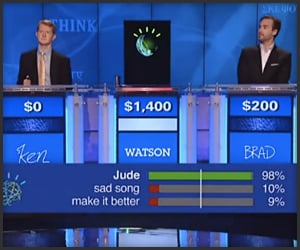
So who caught the Jeopardy! IBM "Man vs. Machine" Challenge that aired for Feb. 14th, 15th, and 16th? It should be, like, required viewing for all nerds, trivia geeks, etc. I mean, I like Jeopardy, and trivia, on a normal basis, but the IBM Challenge took Jeopardy to the next level--which, apparently, includes science, as well as a little bit of what most people might consider sci-fi as well.

A little background for those who don't know anything of what this is about: for the past few years, IBM has worked on creating a computer that can answer questions by reproducing the way human beings answer questions. "Watson," the computer's name, is loaded up with a ton of data, and has algorithms that allow him to pick out the key words in the Jeopardy clue, sift through his data for possible answers, and predict how likely the terms his algorithms picked out might be the answer. The scientists' hope is that one day this sort of artificial intelligence would be beneficial to, say, doctors working in an extremely isolated area, who may not have access to medical textbooks and other informational resources, may be able to plug symptoms into the database and have the computer spit back the diagnosis and its treatment. You can watch the entire 3-day challenge through Youtube if you'd like.

Varying opinions on artificial intelligence aside, I found the whole thing so very fascinating. It was not that Watson knew more than Ken Jennings or Brad Rutter; I'm fairly certain that they were all very capable of answering the majority of the questions. I'd be curious to see how they programmed Watson to, shall we say, "buzz in" to answer. Because when it comes down to it in Jeopardy, it doesn't matter how quickly you figure out the answer to the clue so much as how fast your reflexes are. So where did the IBM scientists draw the line at Watson's reflexivity? There would be no doubt that a computer's so-called "reflexes" would be much faster than a human's hand-eye coordination. I suspect that Watson answered so many questions correctly not because he knew more than Ken or Brad, but because, with his computer reflexes, he was able to buzz in more quickly than either man. This frustrates me quite a bit because it totally messes with anyone doing scientific observations, augghhhhh!

But that is an issue for IBM to consider for the future, and not what I want to focus on here.

How, you might ask, is what Watson does any different than one of us plugging a question into Google and getting back possible answers? And that's a very good, legitimate question. The difference is in how the data is stored. The Internet as we know it right now is not raw data: instead, it's data that has already been organized into "un-break-down-able" webpages by other human beings. When you type a question such as "How many U.S. presidents had/have a daughter as their oldest child?" into Google, you'll only get an answer back if someone else has already sorted through the data and written up the answer. Otherwise, you'll notice, you'll get hits for related sites, such as "children of U.S. presidents," "geneologies of U.S. presidents," and so on. It's possible, of course, to figure out how many U.S. presidents have eldest daughters via those related sites, but that takes the usual amount of time it takes a human being to solve such data organization questions.

Lots of really smart people have, in TED talks, proposed the project of something like "Internet 2.0," in which all of the data in the world is just put out there for anyone to access and play with as they want. In such a case, typing the question "How many U.S. presidents had/have a daughter as the oldest child?" will prompt the system to sift out the keywords in the question--U.S. presidents, daughter, oldest child--and then limit the data shown to just that which fits those keywords. This is essentially how Watson works. Internet 2.0 would mean that all of this data in its pure unadulterated form would be available, and if we wanted to find an answer to something via an Internet search, we wouldn't have to rely largely on earlier people already answering those questions.

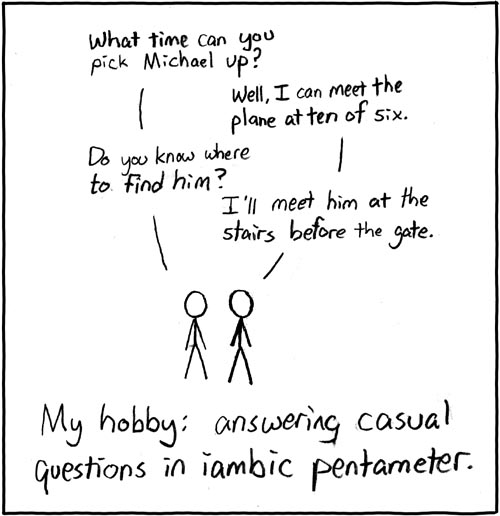
The thing is, most people don't realize until it is explained to them that the way we process language and information is NOT like Internet 2.0, but much more similar to a Google search. We humans loooove patterns: we organize information in them, make patterns out of nothing if need be, remember better if given mnemonics. We remember simple childhood nursery rhymes far better than passages of prose, because rhyme and meter organize the data of language into patterns that we have a much easier time memorizing.

xkcd.com
If I asked you to recite the letters of the alphabet, nearly all of you would start, "A, B, C, D...". (Some of you might even sing it!) No one ever considers saying the alphabet "out of order," even though if I gave you all 26 letters eventually, that technically still counts as reciting the letters of the alphabet. If I asked you to finish the ditty, "Hearts, stars, and horseshoes..." you could probably rattle off the rest of it without much conscious thought. If I told you to put the Lucky Charms marshmallow shapes in alphabetical order, it would probably take you at least a minute to do so. If you asked me to tell you which animal follows the Rabbit in the Chinese Zodiac, I could tell you... but only after I'd recited through the previous animals in the Zodiac, in Chinese. (It's dragon, by the way: long.) And so on; I'm sure you can think of more examples now.

Artificial intelligence as it currently stands does not do this. For Watson and others, they are aware of the most common way of reciting the alphabet, but if asked to recite the alphabet in random order, they could probably do it with no much more effort than they could do it in the "traditional" way. This has both its pros and cons. On the plus side, Watson can much more easily sift through raw data and come up with brand new ways to organize it. On the downside, natural language processing is really a blindingly fast mental process, as we humans take shortcuts to get to answers much more effortlessly than if we had to go through what Watson has to go through every time we wanted to get answers. And, if you watch the Jeopardy episodes, occasionally Watson does some really stupid things that no human would do, and I'm sure the IBM scientists are now scrambling over themselves trying to figure out why oh why Watson did that. (Seriously, watch it. It only takes an hour. It's incredible.)

When a human answers questions on Jeopardy, we don't do it as Watson does, sifting through all the data we possess and ranking possible answers in order of their likelihood to be correct. I don't even know how a human does it, because I haven't taken enough linguistics or cognitive science classes. All I know is that, thus far, a computer has not been able to replicate natural language processing.

onlineeducation.net
Can it ever? I'm not sure. Natural language processing is what allows us to enjoy reading. It's the emotional and aesthetic connections we make while our minds process text that allows for enjoyment. We might laugh when a character makes a social blunder because we, or someone we know, have done something like that before. We cry when a character's loved one dies because we, too, know the pain of a loss of life. We sit up straighter at attention when we recognize a parallel between one text and another we read long ago. And sometimes, if we recognize too many of the same parallels between texts, that becomes a trope or a cliche, and that can diminish our enjoyment of the texts as well.

There are some things that computers are not yet able to replicate, and one of them is the interactive experience between the reader, the text, and the world in which both of them exist.

I challenge you to think about that the next time you open a book.

Wednesday, February 2, 2011

Discussion: A Case for Rereading

My English teachers and professors always used to say that if they had all the time in the world to teach their students, they would tell everyone to read the assigned books at least twice before discussing them. I had always kind of generally agreed, but never realized the significance of rereading until the end of last semester, when I reread, for the first time since August, Mockingjay in preparation to write my Hunger Games paper.

Like most other insane Hunger Games fans, I bought a copy of Mockingjay at midnight on August 24, and preceded to spend most of the night and the next day reading it. Okay--I wouldn't call it "reading." More like guzzling, perhaps. I guzzled Mockingjay, swallowed it so fast I practically choked a few times. My eyes devoured the words on the page at such a frantic page they blurred and I got a headache. I closed the book at around 9:30 the next night, feeling like I had run a marathon, and with a large dose of "what the heck just happened?".

I appreciated Mockingjay when I first read it, I guess. I wasn't as angry and disappointed as other readers were, but I had this feeling like I had missed something important in the book. I had, after all, just consumed the book the way a contestant might inhale food in an eating competition. Obviously I can't have remembered details or nuances, only the big, broad strokes--and those had been unexpected and unnerving.

But oh man, when I reread Mockingjay in December, it was like a whole new reading experience. Now that I knew how it ended, I was reading to more closely examine the path that Suzanne Collins took to get us there. I discovered so much that I had missed the first time around, details that led up to the therefore very appropriate conclusion: "that character got what was coming to him/her," or "wow, that character is much more subtly sinister than I realized."

I also noticed the larger themes of the lose-lose situation that is war; the fragility of relationships in the face of decisions that question one's definitions of humanity. There is no black-and-white in war. War twists people so that even those whom we'd consider "good" may do abhorrent acts in the name of their creed.

And the biggest revelation, of course, was that Mockingjay ended exactly the way that it had to. It was a conclusion that had the entire series had been building toward. I finished it for the second time, finally coming to terms with the course that Collins had set for all her characters. I don't think I like it as much as the first book (the pacing! the thrill! the anticipation!), but I like it more than Catching Fire now. It's also definitely a book that I will go back to, again and again.

The point of my Mockingjay anecdote? Rereading gives you the opportunity to notice things you might not have on your first read-through, especially if you were busy poring over the pages, flipping them at screamingly high speeds in anticipation of what's going to happen. Now that you know the big events that await you in the plot, you can focus instead on all the delightful things about the book that you missed: the wit, or the language. For English class, you will notice the symbolism or themes--yes, it took me a reread before I noticed even the painfully obvious symbolism in The Scarlet Letter (which, for the record, I actually like).

I wonder how often or how much my opinion of a YA book I read would change if I read it twice before reviewing. I can think of several books to which rereading was kind. I can also think of a few to which my rereading it would not be so kind. (And that's probably a reason I haven't reread them: I'm scared of how dramatically my opinion of the book might change.)

Some questions that I have, then, after all this thinking about rereading, are:
  • Should a book review be based solely on one's first and/or only readthrough of the book? Can it capture the fullness of the book?
  • What are the benefits to reading a book at least twice before reviewing it? What are the drawbacks?
  • Should I really take the time to reread a book that I disliked, to see if I might like it more after a reread?
  • When someone says that a certain book is their favorite, does that mean that it stands up to rereads, or that it impressed the hell out of the reader the first time through? If your opinion of a book changes with rereads, what then is the definition of a "favorite book"? (This is something I obsess about because, y'know, I like making and updating lists to keep track of the relatively inane things in my life, such as my all-time favorite books ever. This is also something that I've been thinking about recently because I'm in the middle of rereading some old favorites right now and they're just not doing it for me, which makes me sad and also makes me doubt my stability as a reader.)
  • What are the complexities involved in recommending a book that you once loved, but, upon rereading, you no longer liked that much?

The one thing that I know for sure, though? We crazy book people will rarely, if ever, have the time to reread every single book we read. And that makes me a little sad. I have that in common with English teachers. :)

Saturday, December 11, 2010

Discussion: Professionalism, Presence, and Their Influences on the Reading Experience

Back when I started reading YA in the early 2000s, authors were still unapproachable mythical figures to me. They were usually nothing more than a bio blurb and still photo on the back jacket flap of a book, plus maybe a website if he or she had it. All I knew about them was that, in my mind, they were celebrities, but they were celebrities with no trashy tabloids following their every moves, exposing all their secrets to the whole wide world. In those days, authors were pretty much equivalent to their books, and that was that.

hotdesign.com
Of course, that's hardly the case nowadays. Nearly every YA author now, especially debut authors, have blogs, Twitter accounts, and Facebooks on top of just the standard noninteractive author website. Author presence on the Internet is often incorporated into a publisher's marketing plan for books: if a debut author does not have a blog prior to their book being published, they are often encouraged by their publishers to start one. Even authors who have written dozens of award-winning books over several decades practically need to establish an online presence, else they will likely not capture the attention of the modern audience.

It is because of this shift in book publicity, more so than because I started blogging about books, that has caused my reading experience to change. Very rarely now can I read a book and have it stand on its own. When I read now, I almost always think about what I know about the author, either from my personal interactions with him or her, or the way he or she presents him/herself online. Nowadays I often get to know the author through Twitter or their blog posts before I read his or her book. This is totally different from my reading experiences even just a few years ago, when finding out more about an author came only after I had read his or her book.

This has both a positive and negative effect on a number of reading- and blogging-related things, but for this post I am going to stick only to the reading experience itself--that is, the act and enjoyment of reading the author's book. It's positive because an author's online presence may actually do as the publishers want and cause me to pick up a book. It may be that the author's tweets make me laugh, or I find their blog posts well-written or thought-provoking. Sometimes I'm surprised when I finally read their book and discover that it's so different from their online presence. This has been both a good or bad thing in the past.

It's negative when an author's online behavior causes me to rethink my support of them through reading, buying, or reviewing their books. There have been instances in the past when I've really enjoyed an author's book(s), only to discover in some not-so-obscure corner of the Internet that he or she has behaved in ways I find deplorable: immaturely ragging on people they disagree with almost to the point of online harassment, expressing their opinions in a narrow-minded or offensive manner, belittling the intelligences of their YA audience.

What do you do when you come across something like that? I can no longer not let it influence my decision to support that author's books...and it is my opinion that neither should I, as a consumer, be expected to separate the two. Publishers should know that with their push to incorporate authors' online presence into marketing and publicity, they run the risk of it having the opposite effect on readers. I am a firm believer that there is no such thing as good publicity vs. bad publicity: it's what you choose to do with the available opportunities for publicity that determines its effect on my reading decisions. If you choose to assert your right to mouth off, insult people, and express your controversial opinion on a sensitive subject--and I am not saying you don't have the right to do so--just keep in mind what the consequences regarding your public image and royalty statement may be.

Consider how this occurs in other forms of media and entertainment. Does hearing about Lindsay Lohan's messy and rehab-oriented behavior, or Nicholas Cage's debt and tax evasions, or Tiger Woods' adulterous behavior influence the way you approach their more professional performances? For me it unequivocally does. I can no longer rewatch The Parent Trap or Mean Girls (and both are movies I love, by the way, no shame) without thinking about how Lindsay has gone downhill since then. And I'm less inclined to watch any of Nicholas Cage's future movies because of the fact that I now know he is an extravagant spender with poor finance skills. I mean, dude, you're a multimillionaire. I don't know whether to be more impressed or embarrassed for you that you are able to blow through your seven-figure paychecks.

I'm not trying to say that, because of their authorly status, authors should only be considered their public persona. Of course you are human beings as well, individuals who are also entitled to your personal opinions. But anything that involves a public sphere such as the Internet requires self-policing. Even bloggers--all bloggers, regardless of site traffic or your blog's focus--cannot escape this fact. For example, I am not going to write ranty, ill-informed, and offensive posts about things that irritate the heck out of me. I try to limit my use of profanity online (okay, and in person too). I don't start prolonged arguments in comments that spiral into passive-aggressive personal attacks that have very little to do with the original point of dissention. In fact, I prefer not to make personal attacks online, period. (I'll save ranty moments for in-person conversations if they are necessary, thanks.)

This does not mean I'm Switzerland. Of course I have opinions and make them; you, dearest blog readers, of all people, would know that. But it's about presentation. It's about the way you make your point. And it's also about the willingness to be open to dialogue and dissenting viewpoints, but that's another topic for another post, don't worry I'm already working on that. I may even agree with your opinion, but if you choose to present your opinion in a close-minded, unintelligent, and vindictive manner--in other words, if you choose to be disrespectful when speaking your mind--then you lose my respect. And this has happened to me before, with both authors and bloggers, so it's not just a hypothetical situation.

Yes, the Internet allows for more anonymity, and people are always bolder with the safety of anonymity. Sometimes, this anonymity turns into bad, even terrifying, situations, such as with the influx of cyber-bullying that has caused too many people to commit suicide this year. But don't forget that things on the Internet are very rarely truly anonymous. There are always ways to track down who said what, if you have the time and resources. Things published on the Internet will stay there forever, even if you choose to delete them later. The Internet has given us more freedom, but freedom does come at a price, and if you're not careful, you may be paying dearly for it.

So...what do you guys think? Have you ever been influenced, either positively or negatively, by an author's online presence? Can you separate an author's behavior from your enjoyment of his or her book? Should you? Does this professional/respectful online presence apply to bloggers as well? Should it?

Monday, December 6, 2010

What is love, anyway?

I'll be 22 in the spring. Don't worry, this is NOT a post about me complaining about my relationship status. Related thoughts, though, just can't help occurring when you're a twenty-something-year-old female with female friends. Topics like marriage (ahhhhhhhhhh) just seem to inevitably crop up. The scary thing is, some of my friends want to get married around 25. Allowing a year for the engagement, that gives us less than three years to meet someone, get to know them, realize you want to spend forever with them, AND convince them/find out that they feel the same way about you.

I get tired just thinking about it.

The truth is, I have so little experience in the romance department that I have no freaking clue what I'm doing or what to do. This past week I've made some pretty big self-discoveries regarding what kind of guys I fall for, what I'm looking for relationship-wise, the difference between a casual crush of mine and a serious one, and so on. But I still feel like I'm, I dunno, Lewis & Clark or someone like them, plunging down an utterly unknown river, swollen with spring runoff, with only a flimsy low-grade plastic paddle in my hand to fend off alligators and loose logs.


Usually when I need help I often look towards books first, but lately that's just been frustrating, because books always seem to, well, romanticize romance. Somehow, some way, things work out, usually with this big, swoony scene at the end where the guy confesses his love to the girl or the girl admits to the guy that he was right about her, and they kiss and everyone's happy, the end. And how about all those books that have enviously smooth "getting to know you" romantic progressions, eh? The first encounter goes well, the love interest continues to approach the MC, there is no doubt in either of their minds that they like each other. When in real life (or my life, at least) it usually goes: initial encounter goes well, subsequent encounters are much more ambiguous (does he/she like me as just a friend, or as more than one? or do I not even cross his/her mind at all?), until eventually you are suffocated by a plague of uncertainty and confusion.

Where is the doubt in YA romances? Where is the ambiguity of interactions? Why is there a sad lack of examples that could give me any sort of insight into the way "real" romances progress, at least in my opinion?

I know, I know, I know that in telling a story--whether it be entirely fictional or your own real-life tale--one tends to emphasize the good points and deemphasize the bad. And as a reader we are also relatively passive observers with the benefit of an outsider's perspective to the very things that so confuse us when we're actually participating in them. You know how in movies there might be this big misunderstanding scene where neither character says what they truly mean to one another, only they don't know that, so they both think that what the other is saying is how they're really feeling, and then they turn away and the camera shows them making a miserable face at how much it just killed them to lie to the other person like that? Yeah. We're the audience, so we get the benefit of this camera view and get to see the true feelings that the other character doesn't see.

I want to be that "me" audience member for my own life. Maybe then I'd be able to figure some things out.

Or maybe I simply watch too many of those kinds of movies.

I used to be more worried that I'd end up alone. Now, I'm not so worried about that, but I do wonder often what it is I should look for in whoever I end up with. How will I know when I have found the right one? If the one that I can see myself with forever has some serious flaws that usually break relationships, how much should I excuse them for those? I hope I don't settle for anyone less than the one who is right for me--note that I say "right for me" and not "perfect"--but I worry that I may not recognize him when I find him.

It's also becoming clearer and clearer to me that I don't want to waste time with relationships that I don't think have a chance of lasting. It may sound harsh, or too cynical, but I believe that I can tell pretty early on in my acquaintance with someone whether or not I feel like a hypothetical relationship between the two of us has a possibility of lasting. That's one of the big things I realized last week: that I may be attracted to a number of people, but that doesn't mean I necessarily want to date them. I'd rather be contentedly single than be in a casual relationship for the sake of, I dunno, having something to do on the weekends or whatnot. I'm not actively looking for The One, nor am I unhappy that I'm not with him yet. I approach things very pragmatically, but believe deep down that eventually, sooner or later, but most likely later, and maybe even a lot later, I will find him. I've watched too many Disney movies and read too many romances to not believe in the idea that maybe, just maybe, I will find someone who likes all of me, who can challenge me intellectually, and who can inspire me to try to make each day the best I've ever lived.

It seems that so many authors and bloggers I know are either happily married or otherwise in wonderful relationships that seemed to have had fairy-tale beginnings, or courtships, or whatever. Can I ask you if that was really how it went, though? Did you have moments of doubt and uncertainty as to whether or not your partner was the right person for you? How did you know that he/she was The One? Who initiated the relationship? Did your own love story unfold like a standard YA romance, or did it have its tough moments, stuff that never gets told in the stories? Are the romances you write into your stories reflective of your real-life experiences, or are they more wish fulfillment? Where, I guess, does the inspiration for those fictional romances come from?

I wanted to save these questions for closer to Valentine's Day, maybe even make a feature out of it (who knows? I could still do it?) but they have been weighing me down for quite some time now so I thought I'd just put it out here.

Peace, love, and happiness, as always.

Thursday, December 2, 2010

"Some of What We Know About Happiness"

I attended a wonderful lecture yesterday by one of my school's most well-known professors, the psychologist Dr. Barry Schwartz. His most famous concept is the theory of the "paradox of choice," which basically says that having more choices may not necessarily be the best thing for your mental state, which I'm sure I've mentioned once or twice in blog posts here.

Anyway, this week is Gratitude Week at my school, so Barry Schwartz gave a lecture called "Some of What We Know About Happiness." Sounds like something you'd want to know about, right? I thought it was wonderful, and so I'm sharing with you my notes on the lecture--with my thoughts in parentheses and direct quotes in, well, quotes--so that maybe you can take something away from it as well!

"Some of What We Know About Happiness" by Dr. Barry Schwartz

www.personaldevelopment-courses.com
1. How is happiness measured?
  • Ask people!
  • Around the world, people are most happy about family, but not on a daily basis; rather, they like the abstract idea of family (This made me laugh, but it is SO TRUE)
  • People are least happy about commuting: "So if you had to choose between a mansion an hour away from work, or a hovel right at your work's doorstep... you should choose the hovel."
  • People are bad at predicting what makes them happy, thus they make bad choices. They also seem to be impervious to instruction, so they continue making bad choices.
  • On a larger scale, can you measure something like gross national happiness, sort of like gross national product? "Well, if governments had to choose between measuring something really important in vague, imperfect terms, and precisely measuring something not so important, they will always choose to thoroughly and precisely measure the unimportant thing." (Again, LOL)

2. What makes people happy?
  • Money. Come on, let's be honest. But there is a "threshold of subsistence" beyond which more money does not make a difference on one's happiness. Rich countries are happier than poor countries, and rich people within each country are happier than poor people, but increasing the wealth of a rich country doesn't make the people happier.
  • Meaningful, engaging, intelligent, controllable work that contributes to the improvement of others' lives
  • Close relationships
  • Marriage, not just cohabitation: "Marriage does make people happier. It makes people much happier for a few years, and then it only makes people slightly happier." (LOL)
  • Security: physical, emotional, financial
  • Democracy
  • However, inequality seems to matter surprisingly little
  • Having norms of ethical conduct
  • If an experience has a good high point (climax) and a good end, people will generally be inclined to think well of it and do it again.

3. What is happiness good for?
  • It feels good, of course!
  • Health: happy people live longer - "So it's better to smoke a pack of cigarettes a day than be happy than to not smoke and be unhappy."
  • Work productivity: happiness broadens cognitive outlook, increases creativity
  • The myth of the suffering artist is FALSE: "The French are not that happy. Their happiness is kind of the equivalent of everyone in that country having gone through a divorce. We don't know yet why this is the case. Maybe they really buy into the whole 'suffering artist' myth. Like, if we Americans believe in it, the French believe in it 5 times as much."
  • Improves social relations: people would rather be friends with happy people

4. How can you be happier?
  • Change your genes--"And by that I don't mean jeans" *points at his pants*--there have been studies that suggest that happiness may be hereditary
  • Pay more attention to what's good in experience and less on what's bad
  • Gratitude is a habit that should be developed
  • Focus on the little things, make it a daily routine to write down things you are grateful for, and eventually this will become habitual
  • Writing (not talking or thinking) narratives about bad/tragic experiences decreases its impact on your psyche; write in a way that helps you try to comprehend the experience
  • Lower your expectations: learn to be satisfied with less than perfection

"So if you lower your expectations, write about your bad experiences, and make it a habit to be grateful, you'll live forever." The end!

(Most of the direct quotes were said facetiously, of course.)

Thursday, November 11, 2010

A Discussion on Negative Reviews

Recently I've come across several posts written by authors in which they expressed their frustration and disappointment over negative reviews of their books written by bloggers. In these negative reviews, the reviewers essentially mocked, bashed, and personally attacked the author, his/her writing, and his/her book. This is not the first time something like this has come up, nor will it be the last.

Now, this is not a debate in which I will take one side or the other. We have all formulated our own opinions about this tricky overlapping spot in the world of writing, publishing, blogging, reviewing, and befriending people. I think it's safe to say that everyone needs to have thick, porous skin: the thickness to let the ridiculous bounce off, and the porous to let in alternate ways of thinking that you might not have considered before.

Here's what I think:

I think it's absolutely essential that we all be honest, straightfoward, and open-minded. Do you realize how many conflicts that escalate into something much, much worse could be avoided if the opposing parties just had an open and civil dialogue about it? So if a book really didn't work for a reviewer, it is that reviewer's right (and I would say responsibility, but I'm not saying that you need to go shout from the rooftops, "THIS BOOK SUCKS. DON'T EVER READ IT" aka the "anti-recommendation") to express his or her opinion about it, and why that book didn't work for him or her. If the book comes up in discussion with a group of people, I think the reader/reviewer has the right to quietly and politely express that the book didn't work for him/her, and to let that influence the reading decisions of the other people in whatever way it may.

It does NOT, however, give the reviewer the right to mock or attack the story's elements or the author's decisions when it comes to plot, characterization, etc.

Sure, we're pretty confused when we find, say,  yet another dependent, breathless, helpless, luuurv-me-or-I-have-no-reason-to-live protagonist in YA paranormal romance. But we don't have the right to write something in our review along the lines of, "I have NO idea why the author would EVER create such a brainless, spineless character. Also, I don't agree with said character's [decision 1], [decision 2], [decision 3]!"

Readers and reviewers, it's not our place to question the decisions that the author makes for his or her book. Those decisions were made a long time before the book reached our hands. To question those things would be like us whining about why a book character has green eyes instead of brown, or why an actor's costume contains a lot of blues and not purples, or why the MC has a soft spot for bad boys instead of nice guys. Those are set in stone: they are not for us to criticize.

I think there's a difference between a character making stupid decisions, and a character making stupid decisions that feel artificial to us. It can actually be a good thing when we get emotionally invested in a story and want to yell at the character, "What are you doing??? Why did you just say/do/think that??? Auuughhh!" But if a character does something that just makes us roll our eyes, or blink and mutter, "What?", or--worse--not care at all, I think that's, for lack of a better word, critique-able. If the character does something that's supposed to make us want to yell at them but instead causes us to react differently (e.g. roll our eyes or, God forbid, laugh), that disjuncture between intent and effect is something I think can, and maybe even should, be noted in a critical review. It's a tricky distinction, the one between author's intent and actually manifested reaction from the audience, but I think it's the crucial one.

The authors who wrote the blog posts also mentioned that the reviewers who had written the negative reviews were aspiring authors themselves, and they warned that this sort of unprofessional behavior will reflect on them badly when it comes time for these aspiring authors to query and make connections within the publishing world. I'm not disagreeing with them: professionalism is all the more important now that the Internet makes things so informal and accessible, and things that get on the Internet typically stay there forever. So you do have to watch how you present yourself online. I have watched both authors and bloggers get slammed for poor online conduct.

However, I'm not discouraging you from writing critical reviews, as long as it's done professionally, and all personal attacks remain out of the discussion. I think that it's natural for aspiring authors to examine books from a writer's point of view. I'm an aspiring author myself, and I always try to look for logical consistency within a book: Are the characters' behaviors believable? If fantastical elements are involved, do they follow the "grammar" of their world and not violate their own rules? Does the writing effectively portray what the author intends it to do? These are what I write about when I have to write a critical review. In no way do I wish to make a personal attack on the author. Would it really be that hard to take an extra 10 seconds before posting and put yourself in another's shoes, think about how you'd feel if someone said those things about your writing? Yeah, not so great, I'd imagine. So there's no need to make disparaging comments such as "I have no idea how [book name]/[author] got published." What if someone were to say that about your book in the future?

Sometimes, an author's writing just won't do it for you. And sometimes, authors, a blogger's reviewing style won't do it for you. So then you just quietly stay out of one another's way. Know what works for you and what doesn't, and immerse yourself in as little negative stimuli as possible. Neither party has the right to spread around your opinion as The Gospel. Trying to force upon others your opinion that "This blogger sucks, avoid his/her reviews" or "This author sucks, don't ever read his/her books" is the most obnoxious invasion of the private/public sphere disjuncture that can be done. It's okay if you didn't connect with someone's writing, and it's okay to express that politely, as long as you make it clear that it's YOUR opinion. It is NOT okay to try to push your opinions at others, or to think that anyone who doesn't share your opinion is idiotic and not worthy of being heard.

That is all.

Saturday, October 16, 2010

The Crux of Character

Recently I've read a few contemporary realism books that I found myself unable to truly get into. Now, mind you, these are big-name YA books, books that have been raved about for months by a vast majority of the blogging community, awards panels, librarians, book review publications, etc. They are also "issue" books--more specifically, books about the death of a loved one.

I don't know about you, but I always feel compared to give "issue" books a higher rating than contemporary realism that deals with less objectively serious subjects. But the thing is, it frustrates me when an "issue" book receives accolade after accolade when it cannot convincingly answer an extremely important fiction question for me:

Can the main character exist without the book's "issue"?

realbollywood.com
Look--I know that most books are written about an exceptional moment of the character's life, such as a life-changing event or period of growth, or both. There's got to be something that makes that particular slice of the character's life worth writing a whole book about. The death of a loved one is life-changing, definitely--traumatic, tragic, heartbreaking. But I get really frustrated when the character development reads like the character did not even come into existence until this tragic event occurred to them. Surely you must've had a personality before the death? Hobbies? Interests? Worries? Crushes? Then why do you sound like, without your Significant Event, you would be a totally unrealistically simplistic boring non-person?

I used to think that bland protagonists existed only in guilty-pleasure paranormal romances, hidden behind the romantic appeal, okay-ed through the editing process because of the flashy premise. But now I know that they can exist in realistic fiction as well. This time, they're masked behind a sad, sad event that screams "PITY ME", otherwise you will be considered a horrible, insensitive person.

thenexttrain.co.za
There seems to be this misconception that giving your protagonist as few definable traits as possible makes him or her more relatable to the audience. Because they are a blank slate, deeply, irrefutably, life-changingly in love with the love interest, and we are supposed to focus entirely on the transformative, obsessive, all-consuming power of the romance and how neither character can live without the other. They are, supposedly, the everyman or everywoman.

But this is a misconception, because the way to get people to relate to your character? To make your character as specific as possible. Little mundane quirks that bring out the human in your character. Because I am still constantly being surprised at how related so many of us are in our thoughts and experiences. Yeah, human beings are unique creatures, but they also share a whole lot, particularly in adolescence. Everyone feels lonely. Everyone feels misunderstood. These feelings of isolation, frustration, and fear are what differentiate us, but also what draw us in solidarity when we find someone else who feels the same way we do.

Some of the best contemporary realistic YA fiction I've read deal not with serious subjects like death or abuse, but rather with the completely, absolutely, totally, terrifically ordinary everyday concerns of being a teenager: friendship fluctuations, romantic worries, school, body image, adults who just don't get them. I like a serious, thought-provoking, and eye-opening read myself, but I also love it when a more so-called "lighthearted" or "frivolous" YA book really gets what it means to be an average teen. Because--and let's not delude ourselves in the name of sensitivity and empathy--many of us just want flawed, rebellious, and tetchy screw-up characters that we can read about and go, "Oh my God, I am totally like that." And on the rare occasion where I can find a book with a strong premise and a truly well-developed protagonist, well, that's just incredibly cool and wonderful.

I think that writers should ask themselves as they're writing, "Can my main character exist without the catalyst for their story in this book?" Take away the tragedy and what remains? If you draw a blank--if you can't describe the character beyond the embarrassingly basic facts such as living arrangement, primary extracurricular activities, tentative career ideas, etc.--then you really should rethink your character. YA readers are becoming sophisticated enough to notice when a premise remains only a premise. A novel does not truly take flight on a flashy or sympathy-inducing premise alone. That's why some of the best books--or at least some of my favorite books--can have seemingly little or no plot at all. An attention-grabbing premise can garner the pre-hype and release week bestselling status, but only thorough and relatable characterization can make a story memorable across both one and many lifetimes.

Saturday, September 18, 2010

What Makes a Good Reviewer?

The answer to that question is probably best said by a classmate of mine, an extremely talented girl a year younger than me. She's talking about music journalism here, but I think it's so applicable to any other type of writing, particularly reviews:

"The mark of a good music critic is the ability to describe a piece of music so that a listener who has not heard the song can hear exactly what the writer is hearing. It's impossible, but what else can I do but try?
"I love 'Rocky Raccoon' because it's imperfect and atypical. I like it because Paul McCartney's mouth is too close to the microphone, and you can hear him swallowing. His diction isn't very good, and the words seem to roll off his tongue, not quite making it over the edge. The melody is simple, and the lyrics are effortless. Paul's crooning tone adds vulnerability to the song, but the smoothness of the lyrics and the languorous movement of Ringo's downbeat and George's strumming guitar give the tune a lighthearted ambiance." © I.N. 2010

If you can't hear exactly what she's talking about in her description, then pigs are probably flying. I've never heard this song before but I can practically hear it playing right next to me, reading that.

This, friends, is what it means to be a reviewer, or really, a writer of anything. It's describing something in such a way that someone who has no expertise in the subject can almost perfectly understand what you're talking about.

Don't get me wrong: it's definitely hard. It takes lots of practice and direct/indirect exposure to the field that you're writing about and lots of trial and error. As well as a bit of talent. Yes, I believe that people are born and/or shaped to be predisposed to some activities and interests over others, but even that's not enough to be good at what you're doing. It also involves a certain degree of humility, of actually LISTENING to criticism and learning from it, and then learning to separate the good criticism from the so-so criticism.

The way I see it, to write--to transfer anything from thought to language--is to communicate. Doesn't matter if you're only scribbling half-formed sentences in your journal, or drafting an article that's going to appear in the New York Times. They might be different levels of writing, but it's all writing when it comes down to it. To write is to communicate, which means to have an audience. And by "audience," I mean anything from a half-second, grimacing glance before you trash/burn/otherwise destroy what you just wrote, or the legions of readers who will discover and rediscover your writing for centuries to come.

The easiest audience to write for is, arguably, yourself. That's because you know yourself, you can take shortcuts with your writing and still be able to decipher what you are talking about. The more people read your stuff, however, the harder it is to write, and the less easy it is to define the qualities of a work that make people continue to read it generations after it was originally written. What is the reason Homer is still read and taught today? What about Lao Tzu and Sun Tzu, who actually wrote in another language? What is it about their writings that have withstood the tests of time, evolving audiences, and even languages?

Here we go back to that intangible definition of writing that transcends individual language and experiential limitations. As a book reviewer, I strive to describe the book I'm reviewing to myself... my YA-loving friends... readers in general... non-reviewers... my mother's cousin's husband's sister's youngest son's best friend, who HATES reading. On and on and on, attempting to reach whoever manages to stumble across this speck of a blog in this corner of the infinite Internet universe. With every bit of writing I do, blogging or non-blogging-related, I am thinking about audience. Because, from a sociocultural perspective, in our world, those who have language are those who succeed. Sure, you should definitely write for yourself, all of your writing should reflect YOU, but at the same time, the "you" is a form of audience as well.

Language is a construct to bridge--nay, to organize--human thoughts and consciences. It necessarily requires the existence of an audience. And it is the act of a good writer/reviewer that we are able to communicate our thoughts about something to someone who knows nothing about it. It doesn't matter how the reviewer goes about it: they can be snarky, biting, insulting, raving, obsequious. The attitude with which one reviews something is not what I'm talking about right now (and is subject for a different conversation at another time); what I'm talking about right now is the act of communication. My favorite book reviewers have that ability to let me really get what he/she wants to say about the book. And that's what I'm looking for when it comes to writing.

Thursday, July 29, 2010

Why I Want More Asians on YA Book Covers: My Experience with Racism

AHAC.org
Everyone has a story like this. Whether you're white or non-white, the racial majority or the racial minority, you've probably had an encounter with racism that you still remember as That Moment for the rest of your life. Here's mine:

I was in early middle school, 6th, 7th grade, maybe. My family had gone out to the all-you-can-eat buffet lunch at Pizza Hut with several other families. We were all close, due to similar cultural extracurricular activities and the same age range for the children. We kids chowed down our pizzas, breadsticks, and sodas, hungry rascals that we were, and began to get restless while the adults ate leisurely and chatted with one another. I pulled out a deck of cards and engaged some of the others in a game, but 52 cards is not enough to entertain 15 or so kids, and so inevitably there was lots of running, shouting, and being hyper kids at a pizza parlor.
So kids were running around and we were all in general making a lot of noises when one of the mothers caught some of the kids as they raced by the tables for the fifth or so time. "Settle down!" she ordered us in Chinese. "We're the minority, we have to be quiet!"

Now.

In her defense, rowdy kids in a restaurant should definitely be taught to be more considerate of other patrons and their surroundings, even in a family-oriented location.

Aaaaand that's about all I can say for her argument.

I was shocked. Seething with anger. Humiliated for my own race. Disappointed that someone so well educated, so well respected amongst our community, so looked up to by me and others, would say such a thing to kids, teach us, even unintentionally, that this sort of subservient inferiority thinking is acceptable. It's been probably 10 years since the incident, and my heart still clenches whenever I think of it, that day when I lost respect for someone I admired, that day someone--someone of my own race, no less--took my racial identity and slammed it in my face, pressuring me to conform to "acceptable" behavior and beliefs for my race.

Perhaps one might argue that being Asian is not quite as "difficult" as being a member of another race or ethnicity. Asians are considered to be in a similar position as Jews in many ways in American society. We have light skin, generally perform well in school, and obey rules; a large percentage of Asians live in comfortable socioeconomic brackets. To many, Asians do not come to mind when the word "minority" and its stereotypical implications arise. In fact, Asians were held up as the "model minority" back in the fifties and sixties, as an example of what minorities can accomplish if only they put themselves into it and stopped blaming society and situation for their troubles. [Edited to fix ambiguous statements that could've been misconstrued. Thank you, Linda!]

But what we, over many other racial and ethnic groups, have acquired is a passive acceptance of the beliefs and treatment others subject us to. Many Asians do not have that much of a problem being considered the nerd-smart, obedient, socially awkward race. Better than being considered the hoodlum, or the troublemaker, or the good-for-nothing...right? It is, however, our own quiet acceptance of others' assumptions of what our race is like that ensures our position as a racial doormat.

The problem is that Asians self-perpetuate these beliefs of obeisance, one generation after another. The family friend at the pizza restaurant tells us kids to be quiet because we're the minority, thus we shouldn't attract attention to ourselves. She acknowledged that we may be disturbing the other restaurant patrons, but instead placed the responsibility on society's expectations of our race to be meek and complacent. A white mother would've said to her rowdy white kids, "Settle down! You're in a restaurant, not a park. Don't disturb the other patrons with your noise." Her argument is much more situational and individualistic. The kids are held accountable for their own behavior, not the image of an entire race.

I realize there are cultural discrepancies in these two mothers' different reactions to their disruptive kids. You know, East vs. West, collectivism vs. individualism, the sort of thing you study in psych, history, or soc-anth classes. But if we--and by "we" I don't mean just Asians, but everyone else in this whole damn world--continue to allow this racial self-policing to continue, then it's no wonder that white values continue to be considered superior, preferred. It's no wonder that Asians get pigeonholed into certain "types" of personalities and careers, and no wonder that some Asians' backlash to their own culture is so striking and self-hating. It's no wonder that Asian models get taken off the covers of Asian-set or Asian-themed books.

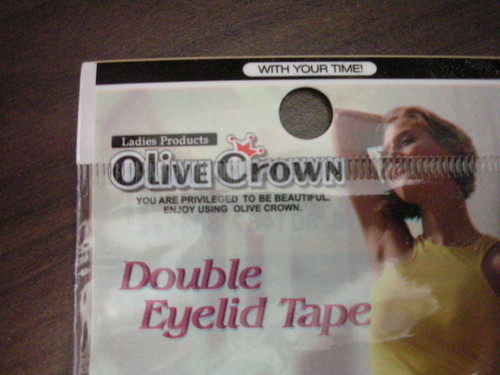
I encourage you to click to enlarge
this image so you can check out the
words below "Olive Crown."
Forget about democracy and equality and diversity: really what has been going on in many institutions, not just the book publishing industry, over the past decades and centuries is the "deracialization" of races that are considered less, the ones that are not "white enough." When I visit Taiwan and walk the streets of Taipei, I'm bombarded with white models blown up dozens of feet high on billboards, beauty parlors advertising their ability to make you blond, selling products to whiten your skin. Asian women undergo surgeries on their eyelids to achieve the wider-eyed, double-folded lid look that--you guessed it--makes them look more white. And I just watched the Chris Rock documentary Good Hair recently, and there are all sorts of reasons that go into why black women spend so much money relaxing their hair or getting weaves. And not all of it has to do with vanity, but rather with a view that society has ingrained in them that relaxed, flowing hair is not only more beautiful, but also looks more professional in the work force.

And whereas you can walk into a school and see groups of black or Latina ladies expressing their pride at being black or Latina, you don't find the same with groups of Asian friends. Asian girls will typically flaunt their Asianness in a subconscious subjection to archaic Orientalist attitudes. Their thinking is, "I'm glad I'm Asian because I have great hair / age well / guys of all races think I'm cute." It's not, "I'm proud to be Asian for me and ME ALONE" the way black women can often say so about their race. Asians are constantly thinking of themselves in terms of other people. And yes, that's part of our Eastern culture as well, this attention to interpersonal connections as the primary way of validation of self, but that absolutely does not give other races and ethnicities the right to walk all over us.

The lack of Asians on book covers enforces the idea that Asians should be the quiet race. Because we are not the proud stars of our own stories, but rather the spectators and secondary characters to others'. We are always the best friend, never the protagonist. When I look at book covers featuring white models representing protagonists that I end up loving and relating to, I subconsciously associate myself with these white characters. It is my "Twinkie-ness" (yellow on the outside, white on the inside) that allows me to enjoy YA books. Reading YA lit the way it's currently jacketed takes away from my Asian identity, because both white society and my own Asian one do not allow for Asians to take a starring role.

Large chain bookstores would not buy Cindy Pon's Silver Phoenix because there was a proud Asian model in traditional Chinese garb on the cover. It's a beautiful, stunning, breath-taking cover, one that had me lusting after it for the fact that it had an Asian girl on the cover alone. Replacing the gorgeous, racially correct cover with a racially ambiguous, awkwardly posed and accessorized Darkest Powers trilogy lookalike offends me. It sends the message that being Asian and proud is not okay. By any standard of 21st-century human rights, is that an acceptable message to send to teenagers?

So we Asians are never going to leap to our feets, wolf-whistle, cat-call, and give rowdy standing ovations in concerts, like the mostly black audience did at the incredible Chester Children's Choir concert I attended at my school over the weekend. Our family and friend gatherings are most likely not going to spill into the streets and be full of color, noise, and spice until the wee hours of the morning. We don't yet lead in the way Western society perceives leaders: as outspoken, well-spoken, and progressive activists.

But to tell--directly or indirectly--an Asian teen that the only way he/she can have "fun," can be him- or herself, is by rejecting their Asian-ness and immersing themselves in white culture... that's plain offensive. It's inhumane.

Society--especially mostly white, American society--has made it an uphill battle for me to understand and embrace my Asian identity. As a teenager I think I would've died from happiness had there been more books with Asian characters and Asian cover models. In a world where popular media inevitably colors our perceptions of racial and ethnic acceptance, it is all the more important that something as trite ("don't judge a book by its cover") yet as monumental (covers are an important selling point for books) as book covers accurately and actively portray the truth about the world's diversity.

Sure, reading fiction can be escapism for the majority of the time. But part of what's so appealing about reading fiction is its relatability, be it contemporary realism or hardcore sci-fi/fantasy. We appreciate--nay, adore--characters whom we can understand, characters whom we can picture ourselves acting like if we were in their situation. Readers are not going to freak out if the MC of a book is of a different gender/race/ethnicity/religion/sexual orientation than them. If that happened, I'd already be wallowing in the scanty, unfortunately rather monotonous Ethnic Literature section with the likes of Maxine Hong Kingston and Amy Tan. POC readers have long read literature featuring white protagonists...and many have enjoyed those books. Why are we assuming that white readers can't do the same? If we call for diversity, why the need to stifle important identities and physical and cultural features of a significant portion of our population?

Let's not demean YA readers' intelligences, please. When we pick up a book with a POC character and see a model of a different race on the cover, we're not going to think, "Oh, YAY! Pretty, beautiful, consumer-happy-making cover!" We are going to think, "Um, hello, did the publishing house not read the book or something? Why is there a white person on the cover when the MC is clearly Asian/black/Latino/etc.?" We're not stupid. We're not unobservant. Give us more credit than that.

Let's have covers and stories that more accurately portray the wide range of beautiful, unique, talented, smart, funny, and, yes, weird people in our world. You want to continue to earn more money, industry people? You want people to continue to love reading, to continue to buy books? Then enter the 21st century and embrace CHANGE, like every single industry and organization out there needs to be doing. Cookie-cutter Wonderbreadland white characters and settings are no longer cutting it. Books should help expand our worldview, not stifle it. The 20th century was full of progress in the human rights field: integration of schools, businesses, and facilities; affirmative action; opening old and prestigious colleges and universities to women.

Let's not take steps backward now.


[Note: This post was inspired by Ari at Reading in Color, who wrote a frustratingly sad post about the Silver Phoenix cover change. Head over to her post to find more links to similar posts written by other bloggers.]
-

Readers: If you are comfortable doing so, please feel free to share your experience with racism either here or in your own post. I welcome your comments, whether you agree or disagree with me. I don't really care what the details of your own opinions on this issue are: it's more important that people talk about this in any degree, and continue talking about it.