Showing posts with label Don De Marino. Show all posts

Sunday, April 19, 2009

Declan Ganley moved his main business concern to the West Indies in 2005 and refuses to answer any question regarding using tax shelters

The Irish Times Public Affairs correspondent Colm Keena has another report on Declan Ganley and his strange business affairs. Ganleys face is plastered on billboards across Dublin this week in a completely disingenuous ad campaign which states that Ganley has a proven record of job creation juxtaposed with Irish Taoiseach (Prime Minister) Brian Cowen. It would appear that Ganley expects people to believe that he has created and/or could create jobs in Ireland. He admitted to BBC Hardtalk that he only employs "a team" in Ireland. This blogger surmises that that "team" includes his Libertas employees like John McGuirk and David Cochrane of Politics.ie.

Ganley has since 2005 availed of a tax haven in the West Indies for his Rivada Networks. This would seem to have preceded the multi million dollar US Defence contracts that Rivada Pacific received on a no competition basis. By moving his concern off shore he has ensured that the Irish people do not share in his "windfalls". Ireland has one of the lowest corporate tax rates in the EU which Mr. Ganley could have availed of but rather than pay 10% corporate tax to the Irish state he claims to love he took his cash elsewhere.
Irish voters in the North West constituency for the European Union should bear this in mond when the enter the ballot box on 5 June.
Ganley has created a tiny handful of jobs in Ireland over the decades and all related to his running a business that is now off shore or a political party that claims to want greater transparency, accountability and democracy.

Rivada funded the early Libertas by employing Naoise Nunn and David Cochrane to work on creating the brand. It is ironic that a company supplying US Defence interests with communication interests and operating from an off shore location helped create a political movement that has the support of nationalists, far right groups and libertarians across Europe.

This is all too weird for words. Like much else in Ganleys history and something that he acknowledged to Jason O'Toole of the Hot Press , if it was in a novel it would be hard to believe. Sadly the Ganley story is all too real.

Ganley through his spokesperson refused to answer questions yet again.


Ganley moved his stake in Rivada to West Indies

FILINGS IN the Companies Registration Office (CRO) in Dublin show that Declan Ganley’s interest in his Tuam company, Rivada Networks, was transferred to a West Indies company in December 2005, a short time before the Tuam company became a subsidiary of a US company based in Colorado.

The Colorado company is involved in large telecommunications contracts in the US with a range of public organisations including the military. However, the profits arising from this business cannot be ascertained.

Mr Ganley, who is a candidate in the upcoming European elections, was asked by way of a spokesman for his party, Libertas, to provide comment on the filings but declined to do so. The auditors of his companies accounts, Michael Cuddy Co, Athlone, Co Westmeath, did not return a call.

Filings in the CRO for a company called Ganley Corporate Management Ltd show that Mr Ganley held the two issued shares in the company up until December 31st, 2005, when they were transferred to Golden Bay Holdings Ltd, with an address in Nevis, in the British West Indies.

In February 2006 a form B5 was lodged with the Revenue Commissioners Capital Taxes Division and forwarded to the Companies Registration Office, having been stamped by the Revenue capital duty section. This form stated the shares had been allotted to the Caribbean company.

Mr Ganley has in the past said that he used Ganley Corporate Management for the development of business projects.

The annual return for the year to May 16th, 2006, for Rivada Networks Ltd, which is based in Mr Ganley’s home in Tuam, Co Galway, show its 100 issued shares were owned by Ganley Corporate Management Ltd as of the end of that period. The company was incorporated on November 11th, 2005. On that basis, it appears the company was owned by Ganley Corporate Management, and through it by Mr Ganley, up to the end of 2005, when ownership was transferred to Golden Bay Holdings in Nevis.

The Rivada Networks accounts for the year to December 31st, 2006, say the company is the wholly-owned subsidiary of Rivada Networks LLC, of Aeroplaza Drive, Colorado.

It is not known when this company was incorporated and the date when the Irish company became its subsidiary is not given in the accounts.

The accounts also state that the directors of the Tuam company, Declan Ganley and James O’Reilly, had no interest in the shares of the parent company at the beginning or end of the 2006 year.

The various accounts filed by Rivada Networks, Tuam, indicate little by way of commercial activity by the company. Its accounts continued to state that neither Mr Ganley nor Mr O’Reilly had any interest in its US parent up to October of last year, when Mr Ganley was asked about the fact. He declined to comment, but a week later a new set of accounts for the 2007 year was filed in which it was stated that the two men did have an interest in the US parent. However, the accounts for earlier years have not been amended.

The new 2007 accounts state that the Rivada group was restructured during that year. On March 1st, Rivada Networks LLC became a wholly-owned subsidiary of Rivada Networks International LLC, of Delaware, as did Rivada Networks of Tuam. The accounts state that Mr Ganley had a 45.902 per cent shareholding in Rivada Networks LLC at the outset of 2007, and a 43.2071 per cent shareholding in Rivada Networks International at the end of the year.

Mr O’Reilly’s shareholdings went from 4.1966 per cent of the original parent at the outset of the year, to 4.1422 per cent in the new parent at the end of the year. It is not known who else has shares in Rivada other than Mr Ganley and Mr O’Reilly.

The statement that Mr Ganley had no interest in the parent company of Rivada Networks at the time when it was apparently owned by Golden Bay Holdings is in keeping with the filings for Ganley Corporate Management Ltd. The accounts for the year to the end of 2007 state he had no interest in the company’s parent and the annual return for the year to September 2008 shows Ganley Corporate Management is still owned by Golden Bay Holdings.

Thursday, April 16, 2009

Anti Libertas poster temporarily banned from Politics.ie for calling for Ganley boycott LND calls for Rivada boycott until Eskmos are counted

Anti Libertas poster banned from Politics.ie for calling for boycott of Ganley and his supporters and noting that Libertas with its far right supporters are proto fascists.
Just in from oMahonymunster

You have been banned for the following reason:
Calling for boycots of individuals, referring to individuals as fascists, cop on.

Date the ban will be lifted: 18th April 2009, 08:00 AM

This blogger thinks Barack Obama should investigate Rivada Networks/ Rivada Pacific and count the number of Eskimos that benefit from their no competition US Defence contracts.
It must be note that the deal was aided by Donald Rumsfeld aide Jack Shaw....Shaw was involved in attempts to link Obama's campaign with an Iraqi business man who Declan Ganley "investigated"

Declan Ganley on Neo Con Europe

Friday, April 3, 2009

Ganley gives info to SIPO but fails to publicly say who is funding him. Plus says that Polish loan scandal "Never happened"

Not only has Libertas failed to be transparent and open regarding their funding details Ganley is now contradicting his Polish Libertas leaders who said that Libertas Poland would get bank loans backed by ganley which they would default on and Ganley would later pay. this ruse woukld allow ganley to continue saying that he was not or later on say he did not fund the "election" as he would be merely covering bad debts he had guaranteed.
Asked by Colm keena of the Irish Times about these offered loans that would be guaranteed by Mr Ganley, Mr Ganley said: “It never happened.”

That of course is another fudge. Does ganley mean it never happend YET or does he mean it never happened but soon will or does he mean that his Polish Party are lying about him.

Or a much easier thing to believe Ganley is being opaque and again is failing to give a straight answer. Spin spin mistruths and spin. Will ganley stop this awful attack on people's intelligence and either be transparent and tell the simple truth or give up and go back to his defence contacting for the US military. Obama should be aware that Ganley's Iraqi mentor Jack Shaw is at the centre of a spin which has sought to dicredit sources of his electoral campaign funding.

Ganley has had some tricky slippery teachers. It was Shaw who introduced Ganley to the Eskimo company Nana Pacific.
Any one with info on Ganley's mentor Ronald Reagan's man in Saudi Arabia Don Di Marino aka Donald N. De Marino aka Don De mMarino should email peoplekorps@gmail.com
Friday, April 3, 2009
Libertas responds to request for funding details


COLM KEENA, Public Affairs Correspondent

LIBERTAS HAS replied to questions from the Standards in Public Office Commission about aspects of the funding of its campaign last year against the Lisbon Treaty.

The organisation has also supplied the commission, as required by law, with a copy of a bank account into which all political donations received during 2008 should have been lodged. The information has not been made public.

Last month the commission sent a report to Minister for the Environment John Gormley in which it stated that Libertas had failed to respond to requests for information about loans to the group, and other matters. Libertas said it had not been told there was a deadline for supplying the information.

The commission asked Libertas about the loans after it learned from media reports that founder Declan Ganley said he had organised a credit facility for Libertas.

The report said Mr Ganley wrote to the commission on August 13th, 2008, confirming that Libertas had received a personal loan from him “in respect of which a detailed legal agreement and repayment plan in accordance with commercial lending norms” had been agreed. The commission sought further details but these had not been supplied at the time of the publication of the report.

The commission had also been seeking information on the status of persons who media reports indicated had been working for Libertas while being employees of the Irish arm of Mr Ganley’s US-based company, Rivada networks.

Libertas has supplied the commission with a copy of a bank statement for 2008 of the account under which in law it is obliged to lodge all political donations received. It has also supplied a certificate stating that all funds lodged were for political purposes.

A spokesman for the commission explained that the information in the bank statement cannot be disclosed. He said the Libertas response would now be considered. A call to a Libertas spokesman was not returned.

Under the law, the money lent to Libertas would not be a donation if it was given on normal commercial terms and so would not have to be lodged to the bank account designated for donations.

There is ongoing controversy in Poland over reports that Libertas there was offered loans that would be guaranteed by Mr Ganley, Mr Ganley said: “It never happened.”

Saturday, March 21, 2009

Declan Ganley and Iraq from the vaults


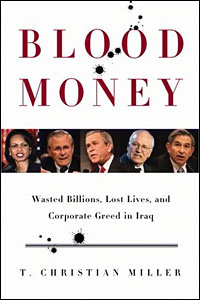
If you have not bought T. Christian Miller's Blood Money you should. It features some information on Declan Ganley in Iraq. It does however give a great deal of info on Jack Shaw who was Ganley and Don Di Marino's pal in Iraq. More on Ganley and Irag from earlier posts.


Here is a contemporary article by Milller originally from the LA Times Published on Wednesday, July 7, 2004

by T. Christian Miller

WASHINGTON — A senior Defense Department official conducted unauthorized investigations of Iraq reconstruction efforts and used their results to push for lucrative contracts for friends and their business clients, according to current and former Pentagon officials and documents.

John A. "Jack" Shaw, deputy undersecretary for international technology security, represented himself as an agent of the Pentagon's inspector general in conducting the investigations, sources said.

In one case, Shaw disguised himself as an employee of Halliburton Co. and gained access to a port in southern Iraq after he was denied entry by the U.S. military, the sources said.

In that investigation, Shaw found problems with operations at the port of Umm al Qasr, Pentagon sources said. In another, he criticized a competition sponsored by the U.S.-led Coalition Provisional Authority to award cellphone licenses in Iraq.

In both cases, Shaw urged government officials to fix the alleged problems by directing multimillion-dollar contracts to companies linked to his friends, without competitive bidding, according to the Pentagon sources and documents. In the case of the port, the clients of a lobbyist friend won a no-bid contract for dredging.

Shaw's actions are the latest to raise concerns that senior Republican officials working in Washington and Iraq have used the rebuilding effort in Iraq to reward associates and political allies. One of Shaw's close friends, the former top U.S. transportation official in Iraq, is under investigation for his role in promoting an Iraqi national airline with a company linked to the Saddam Hussein regime.

The inspector general's office — which investigates waste, fraud and abuse at the Pentagon — has turned over its inquiry into Shaw's actions to the FBI to avoid the appearance of a conflict of interest, the sources said.

The FBI also is looking into allegations, first reported by the Los Angeles Times, that Shaw tried to steer a contract to create an emergency phone network for Iraq's security forces to a company whose board of directors included a friend and one of Shaw's employees.

Shaw, who held top positions in the Reagan and George H.W. Bush administrations, declined to comment for this article. In previous interviews, he has denied any financial links to the companies involved or receiving any promises of future employment or other benefit.

Shaw justified his investigations under a special agreement with the Pentagon inspector general, Joseph E. Schmitz. The August agreement created a temporary office headed by Shaw called the International Armament and Technology Trade Directorate. Its mission was to cooperate with the inspector general on issues related to the transfer of sensitive U.S. technologies or arms to foreign countries.

Shaw frequently cited the agreement in his dealings with reporters and the military, telling them it allowed him to "wear an IG hat" to conduct investigations. In a recent letter to the inspector general, he said the agreement gave him "broad investigatory authority."

That contention is the subject of dispute, however. The agreement states that Shaw "may recommend" that the inspector general initiate audits, evaluations, investigations and inquiries, but it does not appear to give him investigative powers.

"Jack Shaw was never authorized to do any kind of investigation or auditing on his own," said one source close to Schmitz. "The agreement was not for that. He's trying to cram more authority into that agreement than it gives him."

Schmitz canceled the agreement two weeks after Shaw was first accused of tampering with the emergency phone network contract. Schmitz declined to comment, but in his letter canceling the arrangement, he praised Shaw for "outstanding leadership."

Shaw used the agreement to win permission to visit Iraq last fall. In an Oct. 28 letter to Army Gen. John P. Abizaid, head of the U.S. Central Command, Shaw said he wanted to "investigate those who threatened the national security of the United States through the transfer of advanced technologies to Iraq."

Specifically, Shaw said he planned to identify countries that had smuggled contraband weapons into Iraq and catalog existing conventional weapons stockpiles.

Although he did not mention it in the letter, Shaw also was interested in investigating operations at the port of Umm al Qasr.

Last summer, Shaw was visited by Richard E. Powers, a longtime friend and lobbyist. Powers was representing SSA Marine, a Seattle-based port operations company that had won a controversial limited-bid contract in the early days of the war to manage the troubled port.

He also was representing a small business owned by Alaskan natives called Nana Pacific. Under federal regulations, small companies owned by Alaskan Native Americans can bypass the normal process and receive unlimited, no-bid contracts.

Powers suggested there were serious problems with dredging at the port that could be quickly remedied by having a no-bid contract awarded to Nana, which then could subcontract to SSA Marine, sources said.

Powers did not respond to requests for comment. Public lobbying records show that Nana and SSA Marine paid Powers $80,000 last year for his work.

In December, Shaw flew to Kuwait to inspect the port. The military refused to allow him into the facility, however, because of the danger involved, Pentagon sources said.

Shaw and several staffers then went to the port dressed like employees of KBR, the Halliburton subsidiary that has a contract to supply the military with food and other items.

In a KBR hat, Shaw and his staff spent less than an hour at the port, taking pictures and talking with soldiers, current and former Pentagon sources said. The group documented well-known problems there, including the presence of unexploded mines.

A Defense official in Shaw's office acknowledged that they had entered the port despite the military's concerns. He described the disguise as an attempt to conceal Shaw's status, for safety reasons.

He said the military's negative reaction to the proposed visit convinced him that there was serious trouble at the port.

"This Army two-star said, 'We won't let you in the country.' I said, there's something there," said the Defense official, who did not want to be identified. "Everybody had declared victory at the port…. We looked at the port and there were still tremendous problems."

When coalition officials learned that Shaw was at the port, they made a frantic effort to locate him, but didn't reach him until after his return to Kuwait.

"I get this call from [the U.S. military command in Iraq] that said: 'We have an undersecretary of Defense roaming the countryside. We need to locate and secure him,' " recalled a former CPA official. "He's in the country illegally, but we can't arrest him, so we let him finish the tour."

Shaw spent about a week in Iraq, meeting with top U.S. and Iraqi officials. He told several officials that the trip to Umm al Qasr had convinced him that work at the port had to be accelerated. He then suggested that the work could be expedited by awarding the contract to Nana, several former CPA officials said.

"The only time I heard Nana's name was when [Shaw and his team] were in Baghdad," said a former CPA official involved in the ports. "The notion was that this might well be a vehicle where you could in fact get things moving quickly that needed to be done, such as dredging and so forth."

Soon after Shaw's visit, the CPA granted Nana a construction and communications contract worth up to $70 million. Nana then subcontracted $3.5 million in work to SSA Marine, which recently completed the dredging.

Nana also is linked to Shaw's other investigation.

Late last year, Shaw began looking into the award of cellphone licenses in Iraq after receiving complaints from a longtime friend, Don DeMarino, who had worked under Shaw at the Commerce Department.

DeMarino was a director of a consortium called Liberty Mobile, one of the losing bidders in the contest that awarded the cellphone licenses, potentially worth hundreds of millions of dollars, to three other firms.

Relying on information from DeMarino and Liberty Mobile's president, Declan Ganley, Shaw cast doubt on the validity of the awards by leaking to several media outlets information that he said showed corruption in the process, said current and former Pentagon sources. He also provided the evidence he had gathered to the inspector general.

In December, the inspector general's office released a report saying that no basis had been found for Shaw's accusations. The office referred part of the complaint to the British government for further investigation of two British CPA officials involved in the licensing process, according to a copy of the report obtained by The Times.

British authorities exonerated the men. Later, Deputy Defense Secretary Paul D. Wolfowitz wrote to the British ambassador clearing them.

"The British ambassador in the U.S. has received notification that no British citizens are under investigation by the U.S." in the contract matter, a British Embassy spokesman said.

Soon after Liberty Mobile lost the bidding war last fall, Shaw began pushing Nana to win a no-bid contract to build a communications system for the Iraqi police, fire and security forces, according to officials with the now-dissolved CPA and documents obtained by The Times. He then tried to change the language of the contract to allow the creation of a cellphone network, according to interviews and documents.

Nana planned to subcontract the construction of the communications system to a company called Guardian Net. Guardian Net's board of directors was nearly identical to that of Liberty Mobile. It included DeMarino, Ganley and Julian Walker, who works for Shaw as a researcher, according to the documents.

Ganley and DeMarino have acknowledged participating in the attempt to win a cellphone license. Walker could not be reached for comment.

When CPA officials reported their concerns about the Guardian Net plan to Pentagon investigators, Shaw stepped up his investigation of the role of the CPA officials in the licensing process, Pentagon sources said.

Even after the Pentagon canceled the agreement that Shaw had used to justify his probe, he unilaterally continued the investigation, Pentagon sources said.

On May 11, Shaw delivered his report, which concluded that there was "serious, credible evidence of criminal wrongdoing by U.S. government employees pertaining to taking official acts in exchange for bribes."

He acknowledged that the report "directly conflicts" with the December report by the inspector general, which he dismissed as "worthless."

Shaw's report, which The Times has reviewed, claims evidence of a conspiracy to take over Iraq's cellphone service led by Nadhmi Auchi, a British businessman who has been accused of links to Hussein and who was convicted last year in a French court in an unrelated kickback scheme. Auchi maintains his innocence and is appealing.

Auchi, according to the report, paid bribes through a series of surrogates to win the three cellphone licenses and gain control of Iraq's cellular system.

A spokesman for Auchi denied Shaw's claims. He acknowledged that Auchi has an indirect, minor stake in Orascom, one of the cellphone operators. He denied any ownership interest in the other phone companies.

Shaw's report relies mainly on newspaper articles, rumors and secondhand conversations reported by the losing bidders or anonymous sources and "the Arab street," which Shaw calls "a reasonable sounding board for accepted truth."

In the conclusion to his report, Shaw recommends that all the cellphone licenses be canceled and that the contract be awarded to one of the original bidders — as long as the bidder uses a technology known as CDMA, which Shaw describes as superior to other cellular technologies.

Shaw sent his report to the inspector general's office, which turned it over for further investigation to the FBI. An FBI official confirmed that the agency had received the report and had just begun looking into the allegations of bribery.

"While some of the evidence in this report is fragmentary, the dots are connected in convincing and important ways," Shaw said in the report. "Below the deadly serious efforts to restore security and legitimacy to Iraq lies a muted gold rush mentality."