
Hillcrest Modernist Mini Golf, Santa Barbara, CA
The history of miniature golf as an art form
by Jonathan Haeber
In a sense, miniature golf is as artistic as the Louvre, Stonehenge, and the numerous statues, buildings, and monuments that tower over the Lilliputian greens. Like art, the design of a course changes in the realm of time, and attracts the people of its age. Like cinema, miniature golf is a variant of art for the masses. It is the greatest unknown art of the American landscape and its artists are the capitalistic craftsmen that satiated the lower and middle class of their appetite for culture.

Golgotha Mini Golf, Cave City, Kentucky
Romantic Era Emergence (REE) (1867-1916): The early miniature courses, including the Himalayas, were one of three types: the pitch and putt, the regulation par-3, and the executive course. At that time, games of miniature golf involved the use of two clubs: the putter and a short driver. Courses were usually from 50 to 100 yards. They retained the architectural plans and landscaping techniques of the regulation course, with undulating hills, verdant forests, sand traps, and ponds. These early courses imitated nature in all aspects. They reflected the Romantic era paintings of John Constable, one of the most famous British Landscape artists of his time.

Let's Go Mini Golf, Hendersonville, NC
Curvilinear roads and a random setting of the greens describe the typical American miniature golf course of the early 20th century. Most were located at hotels and resorts, and therefore were not yet available to the masses. The only artificial aspect of the REE course was the ubiquitous clubhouse. The clubhouse is the shrine and axis mundi of the mini-golf course, and it has remained as a common element of the course, even in contemporary times.

Sir Goony's Golf, Chatanooga, TN
Post-Romantic Classicism (PRC) (1916-1926): Following the First World War, Americans viewed industry much differently. Concurrently, the 'city efficient movement' was at its apogee. City planning was in full swing, and-- it seemed-- traditional classicism was returning, even on the miniature golf course. In 1916, James Barber of Pinehurst, North Carolina, designed Thistle Dhu, the first quintessential miniature golf course. Word has it, that after having seen his finished course, Barber declared to his designer "This'll do!" and an American icon was born.

Monster Mini Golf, West Chester, Ohio
The plan of Barber's Thistle Dhu was as much Classical as the Par-3 was Romantic. The plan resembles the preeminent source of neo-classical landscape design, the Tuileries Garden at the Louvre. Geometric shapes are coupled with symmetric walkways, fountains, and planters. The elements of the PRC miniature golf course-- much like Classical works of art-- were constructed from artificial materials. Concrete stepping stones and artificial fountains were intertwined with endemic species and natural grass. No longer were miniature golf courses curvilinear and relatively spacious. By 1920, they became compact, efficient, geometric, and above all, Classical.

Par-King Skill Golf, Chicago
Sterile Minimalist (SM) (1926-1950): The Great Depression coupled with a high demand for miniature golf resulted in one of the greatest "art for the masses" movements in American history. Miniature golf was less expensive than its counterpart, the picture show, and was also a more engaging activity. Though the artistic value of the depression era movies is often highlighted, miniature golf courses were equally artistic, in a sterile/minimalist sense. The year 1926 marked the beginning of the most successful time in the history of miniature golf. No longer was miniature golf for the elite estate-owners or Scottish ladies. In 1926, "a pair of high-rolling promoters built a pocket course on the roof of a skyscraper in New York City's financial district". It was not long before the Manhattan skyline was pockmarked with rooftop miniature golf courses. After the invention of the dyed cottonseed hull carpet that same year- a revolutionary step for mini-golf- Manhattan gave birth to around 150 rooftop courses; each one was highly successful

Lexington Old Testament Mini Golf, Lexington, Kentucky
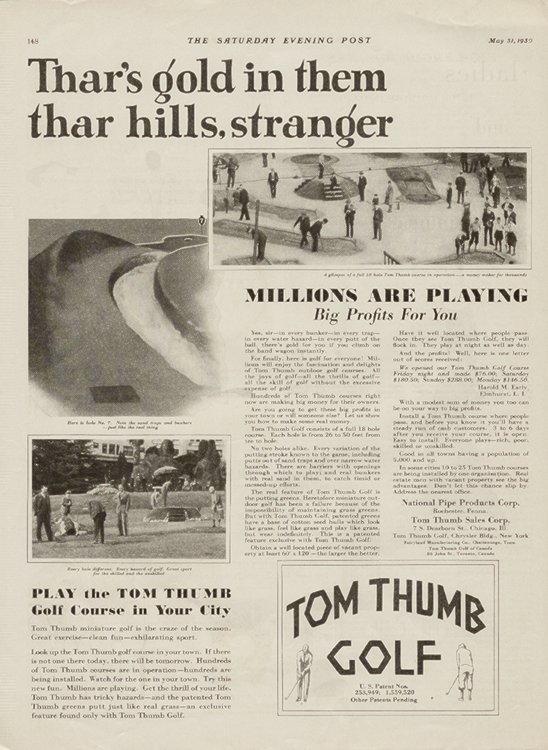
Miniature golf courses were inevitably losing their individual quirks with the initiation of the first miniature golf franchise, Tom Thumb Golf, in 1929. It was estimated that the average prefabricated course could be installed and open for business within six days. As the stock market took a dive, Garnet Carter's Tom Thumb Empire boomed. Tom Thumb was becoming the McDonalds and Pepsi of the early '30s. Of the approximate twenty-five thousand courses in the U.S. at the time, nearly 25%-- or six thousand-- were patented Tom Thumb designs. The individual empire became a corporate one during the high point of mini-golf, and artistic assets were thrown out the window for quick output and maximum profit
.JPG.jpeg)
Larchamps Mini Golf, Larchamps, France
Miniature Golf historian John Margolies calls this era the "1930 Gold Rush." It was a time when capitalistic individuals could use their ingenuity and creativity with the hope of striking it rich. With limited funds, course builders were apt to rely on scrap metal, cheap construction materials, and seedy locations. Therefore, it is no surprise that miniature golf courses were often associated with racketeering. Nonetheless, the makeshift fashion of the non-corporate, non-franchised SM most closely resembled Post-Modern minimalists, such as Sol LeWitt.

Avranches Mini Golf, Beton, France
Much like LeWitt's sculptures, the superfluous elements of the SM course were taken out, such as landscaping, unnecessary hazards, and even benches. Courses reverted to indoor locations, artificial lighting was introduced, and a sort of Fordist efficiency reigned. The loop-di-loop is the ultimate example of an SM course hazard. It is made from a metallic steel or aluminum, painted in monochrome, and presents a simple hazard with the least possible distraction. Similar to LeWitt's sculptures, the "fluff" is omitted in most SM courses. A Smithsonian author aptly described the reason for MiniGolf Minimalism: "As the problems of ordinary life mushroom(ed) out of manageable proportions, (the miniature golf course) was a place where everything (was) brought down to less-than-size".

Star Mini Golf, Reno, Nevada
Cultural Renaissance (1950~1990): In 1931 miniature golf took a dive akin to the stock market, two years earlier. Though the most popular courses managed to stay afloat, the height of miniature golf was over. 'Midget Golf' was no longer the primary get-rich-quick scheme of the 1930s Gold Rush. It evolved into a competitive business that made meager profits. But what Chester H. Liebs calls mini golf's "postwar reincarnation" changed the landscape of the putting greens dramatically. Americans were driving more. Everyone had a car, and freeways became the arteries of America; they also became the salvation of miniature golf.

Hillbilly Golf, Gatlinburg, TN
It was during the second half of the 20th century that mini-golf became widely known as goofy golf, crazy golf, and wacky golf. In order to attract the highway gawkers, massive monuments were the moneymakers for the new courses. The larger, the better, since size attracted the most attention. Equally important to size was shock. A fantastic monument, sphinx, castle, windmill, or gold mine were all common on the new courses.

Castle Golf, Houston
With the inadvertent funding coming from suburban families and dating teenagers the covert artists of miniature golf sculptures had free reign over their creations. Less constrictive ordinances allowed highway-side adventure courses to be a conglomeration of business and artistic expression. The more radical and out-of-this world-- the more expressionistic their works were-- the better. Their investors - 10-year-olds, teenagers, dad and mom - were more than eager to relish in the works along the tapestry of 18 greens. They were experiencing art rather than simply looking at it. They were dating, interacting, competing, and viewing cultural icons all at once. The miniature golf course was the essence of 20th century 'multinomic' order.

Peter Pan Mini Golf, Austin, Texas
It was art, but not only that; it was so much more-a reflection of economy, history, and society all at once. The two growing meccas of miniature golf, Myrtle Beach, South Carolina and Southern California, were indications of such multinomic order. Myrtle Beach is a tourist hub; Southern California is the hearth of American suburbia. It was in the suburban sprawl and tourist trap that miniature golf found its ultimate home, where it became defined as one of the greatest roadside arts of the twentieth century.

Treasure Quest Mini Golf, Memphis, TN
In the Cultural Renaissance era of miniature golf's history, the transition from its status as 'kitsch' art into a unique genre occurred. Miniature golf no longer became pretentious imitation when artists after 1980 incorporated full-scale courses in art museums across the nation. Rather than imitation, it became art's newest inspiration. It was a part of the "collective consciousness of America," or part of our own unique habitus.
Lilliput Mini Golf, Grand Lake, Colorado
As a facet of collective consciousness, it also became a tool for social change and education. In 1995, artist Ken Buhler toured "Putt-Modernism" throughout U.S. art museums. "Putt-Modernism" is described in a 1994 issue of Sports Illustrated: "Players are challenged to putt around or through, among other weird objects, a White House made of empty bottles of AZT and Zovirax (both are drugs used to combat AIDS) on the par-2 Blood on Your Hands 7th hole, the sole of a blue-faced homeless man's shoe on the par-3 Hole-In-My-Soul Blues 17th hole, and the 20 waving arms of an inflatable Jesse Helms look-alike clown, into a bed of inflated breasts on the par-3 15th hole, Censorama. An afternoon of culture as well as a rousing round of miniature golf can be had for a mere $5".

Ahlgrim Acres, Chicago
"It's seeing the Empire State Building the way the sun sees it, the way a hurricane sees it, the way God sees it: as an incredibly intricate man-made wonder that is to be treasured and appreciated not only for its grandeur but for its smallness, even its mortality." From 1950 to 1990 miniature golf did just that. It messed with the American perspective of 'Big' and 'Small,' 'Life' and 'Death.' In the inanimate sculptures of mini-golf courses children and adults found a certain dreamy vitality. But, like the wings of a butterfly, the most aesthetically overlooked things are often ephemeral; Renaissance courses were going to the wrecking balls, and perishing in the final stage and end of its innocence. Twenty-first century corporatism was taking over.

Cannibal Holocaust Mini-Golf, Lariat, Texas
Corporate Mini-Golf (1990 -->): The franchises of the SM period were peanuts compared to the current international conglomerates of mini-golf corporations. Golf-N-Stuff, Putt-Putt, Scandia, Goofy Golf, and Adventure Golf-all of these patented name brand mini-golf courses have become profit ventures. Entrepreneurs prosaically refer to most as Urban Entertainment Centers (UEC's) or, more often, Family Entertainment Centers (FEC's). FEC's usually contain a hodge-podge of amusement attractions (bumper boats, Indy cars), video arcades, batting cages, and, of course, the mini golf course. The location of the FEC is no longer determined by the designer's preference, but by demographical studies, case studies, and 'locational advantage theory'

Glowing Greens Miniature Golf, Portland
American consumerism has become miniature golf's public enemy #1, indeed, Art's worse nightmare. No longer is 'trash' turned into art, like it was during the Depression miniature golf craze; rather, our important and most overlooked art is now disposable, but not precious, given a value, but not valuable. Prosperity has been the death of miniature golf's Renaissance. Ironically, mini-golf's most successful years are during economic strife. Perhaps this indicates that people place a different kind of value on miniature golf-something that cannot be expressed in terms of paper, green ink or gold.

Philly Mini Golf, Philadelphia
----




No comments:
Post a Comment